Device-Level IoT Software Supporting Identification and Location Workflows
Access control management, personnel and asset tracking software, stockpile inventory software, and batch traceability software for processing and refining plants
IoT Software Managing Identification Devices in Mineral Processing and Refining
Beneath every AI function described elsewhere on this website sits a layer of IoT software responsible for managing the identification devices themselves, including RFID readers at leaching bay entrances, BLE beacon networks across flotation banks, and GPS units mounted on mobile equipment. This IoT software handles device configuration, credential provisioning, tag registration, and data collection, forming the operational foundation that AI functions rely on for access decisions, location tracking, and traceability.
Unlike the AI functions covered elsewhere on this website, IoT software for mineral processing does not interpret identification data for decision-making. Instead, it manages the devices and data pipelines that make identification possible across crushing, flotation, leaching, smelting, and refining areas.
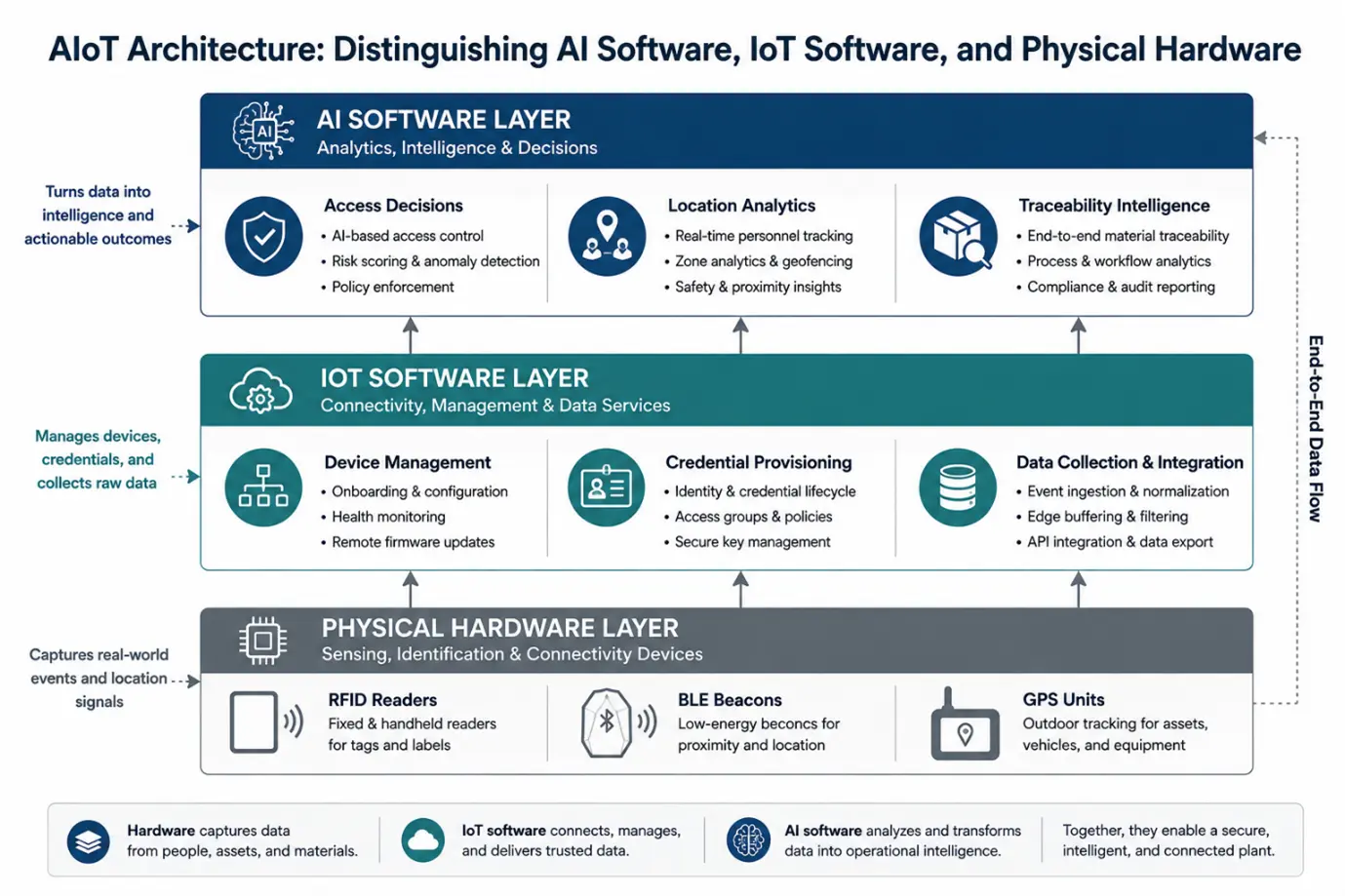
AIoT System: Physical Hardware, IoT Software, and AI Software Layers
This block diagram illustrates the relationship between the three foundational layers of an AIoT solution. Physical hardware devices such as RFID readers, BLE beacons, and GPS units capture real-world data; IoT software manages devices, credentials, and data collection; and AI software transforms that data into operational intelligence through access decisions, location analytics, and traceability insights. The key takeaway is that effective AIoT systems depend on the coordinated interaction of hardware, IoT infrastructure, and AI analytics to deliver secure, scalable, and actionable business outcomes.
Access Control Software
Access control software manages the credential and permission records that govern entry across restricted zones within mineral processing and refining plants, including leaching bays, autoclave rooms, and refining lines.
Access Control Management Software
Access control management software configures and maintains zone-specific access rules, shift schedules, and hazard classifications used by RFID and BLE readers positioned at plant entry points. This software handles the underlying rule sets that access authorization AI functions later interpret, including which credential types are valid for which zones and during which time windows.
Credential and Badge Software
Credential and badge software manages the issuance, renewal, and revocation of RFID and BLE credentials assigned to plant employees and contractors. This includes provisioning new badges for incoming contractor crews working within concentrate handling zones and revoking credentials when personnel leave a site or complete a temporary assignment.
Location Tracking Software
Location tracking software manages the data pipelines that collect and organize positioning information from BLE beacons, RFID readers, and GPS units deployed across a mineral processing plant.
Personnel Tracking Software
Personnel tracking software collects positioning data from BLE beacons worn or carried by operators and maintenance crews, organizing this data by zone, shift, and time for downstream use by personnel location intelligence functions. The software also manages beacon registration and battery status monitoring to maintain consistent tracking coverage across flotation and leaching areas.
Asset Tracking Software
Asset tracking software manages RFID and BLE tag registration for mobile equipment, sample containers, and portable instrumentation, maintaining a device registry that links each tag to its associated asset record. This registry supports asset location intelligence functions by ensuring that positioning data collected from tags maps correctly to the physical assets they represent.
Inventory Software
Inventory software manages the identification records and stock-level data associated with reagents, spare parts, and concentrate stockpiles across a mineral processing plant.
Inventory Management Software
Inventory management software maintains stock records for reagents and spare parts, tracking quantities against RFID or barcode identification at storage locations. This software provides the underlying data that reagent inventory optimization functions later analyze for consumption trends and reorder recommendations.
Stockpile Tracking Software
Stockpile tracking software manages GPS and RFID identification data associated with concentrate stockpiles across stockyards and load-out areas, maintaining location and tonnage records that feed into concentrate stockpile intelligence functions.
Traceability Software
Traceability software manages the batch and work-in-progress identification records that support ore-to-concentrate traceability and batch genealogy functions.
Batch Traceability Software
Batch traceability software maintains identification records linking ore lots to their corresponding concentrate and refined output, forming the underlying data structure that ore-to-concentrate traceability AI and batch genealogy intelligence functions rely on for chain-of-custody documentation.
WIP Tracking Software
WIP tracking software manages identification data for work-in-progress material as it moves through flotation cells, thickeners, and leaching circuits, maintaining stage-level timestamps and batch tag associations that support in-process material analytics functions.
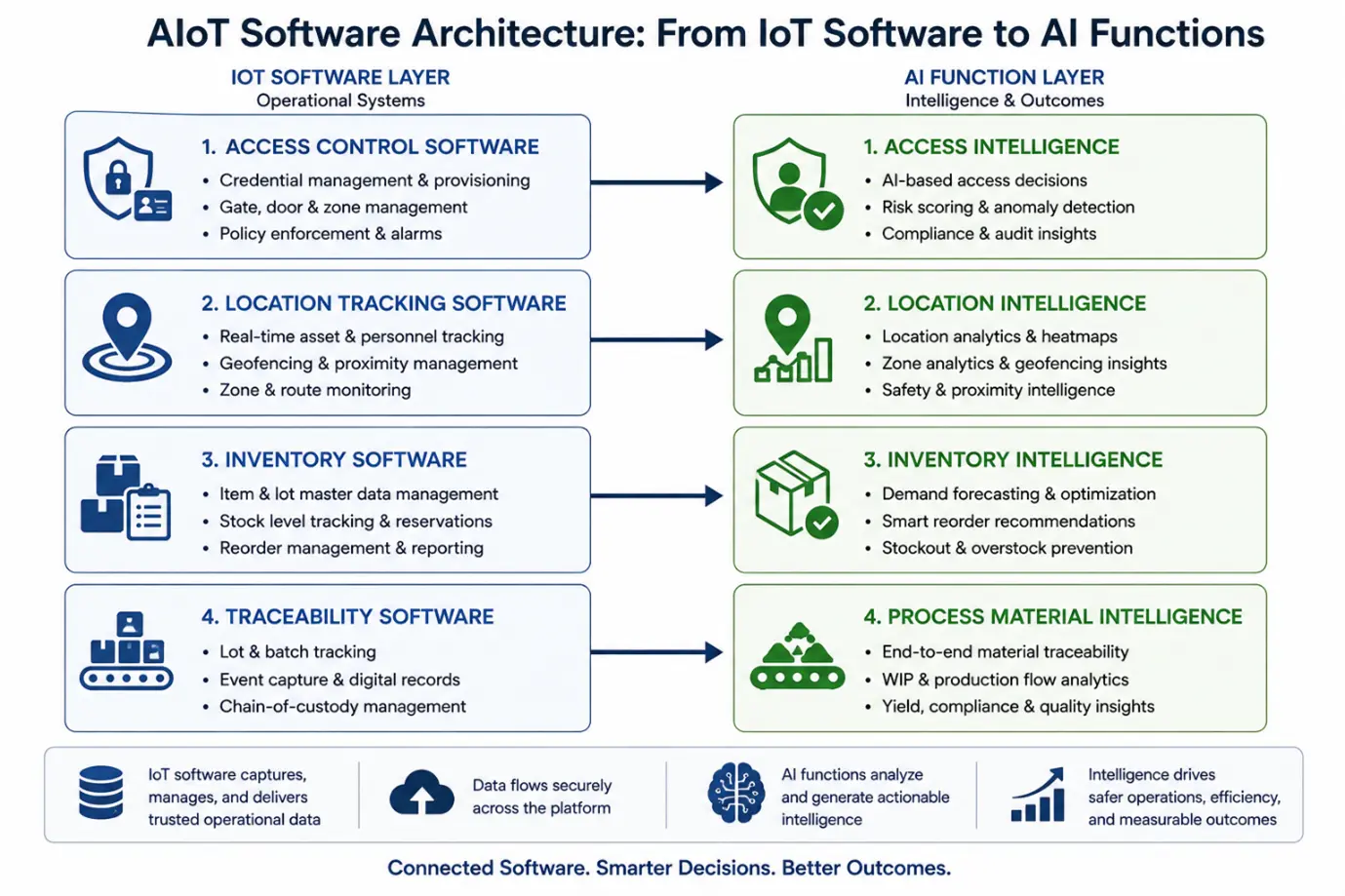
AIoT Software System: Mapping IoT Software to AI Intelligence Functions
Shows how four core IoT software categories—Access Control Software, Location Tracking Software, Inventory Software, and Traceability Software—serve as the operational foundation for corresponding AI intelligence functions. Each software system captures and manages specific operational data, which AI then transforms into actionable insights for access management, location awareness, inventory optimization, and process material intelligence. The key takeaway is that AI value is directly enabled by well-structured IoT software systems, creating a clear path from operational data collection to intelligent decision-making and measurable business outcomes.
Brief Description of Applications
IoT software for mineral processing and refining plants applies directly to managing RFID credentials at leaching bay entrances, maintaining BLE beacon registries across flotation banks, tracking concentrate stockpile identification data in stockyards, and preserving batch and work-in-progress records through leaching and refining stages. This software forms the operational foundation beneath every AI function used across the plant.
