Connecting Identification and Location Software with Plant Enterprise Systems
Middleware, edge data synchronization, cloud and server deployment models, and ERP, MES and SCADA integration for mineral processing operations
Connecting AI and IoT Identification Software with Mineral Processing Enterprise Systems
AI and IoT identification software does not operate in isolation within a mineral processing or refining plant. Access control decisions, personnel location data, concentrate inventory levels, and batch traceability records all need to reach existing enterprise systems including ERP systems for financial and inventory reconciliation, MES systems for production tracking, and SCADA systems for process control alignment. Integration for mineral processing addresses how identification data moves reliably between AI and IoT software and these plant systems.
AIoT Integration System: From Identification Hardware to Enterprise Systems
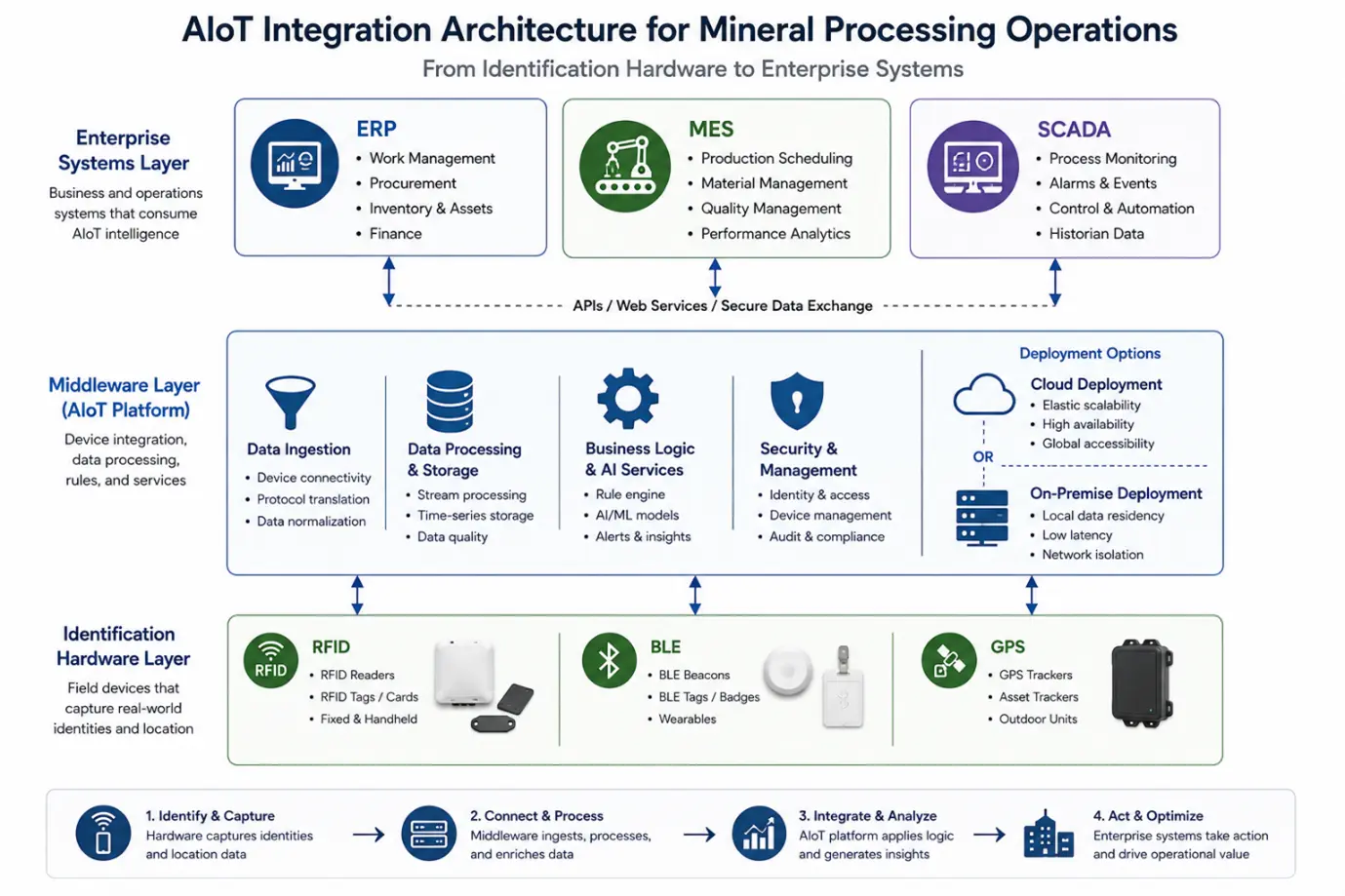
Shows the end-to-end integration path that connects RFID, BLE, and GPS identification hardware with enterprise business and operational systems. Identification devices capture real-world data, which is processed through a middleware system responsible for device integration, data processing, security, and AI-enabled services. The middleware then exchanges information with ERP, MES, and SCADA systems through secure interfaces, while supporting both cloud and on-premise deployment models. The key takeaway is that middleware acts as the critical bridge between field-level identification technologies and enterprise applications, enabling real-time visibility, operational intelligence, and coordinated decision-making across the plant.
Middleware and Connectivity
Middleware forms the connective layer between identification hardware, AI software, and plant enterprise systems, handling data translation and routing across a mineral processing plant.
AIoT Middleware Integration
AIoT middleware integration manages the flow of identification data from RFID readers, BLE beacons, and GPS devices into a standardized format that AI functions and enterprise systems can consume. This middleware layer handles protocol translation between device-level data formats and the data structures expected by ERP, MES, and SCADA systems.
Edge Data Synchronization
Edge data synchronization maintains local data processing capability at remote or connectivity-limited processing sites, such as leaching plants located away from primary plant networks. Identification data collected at the edge is synchronized with central AI software and enterprise systems once connectivity is available, preventing data loss during network interruptions common in remote mineral processing locations.
Deployment Models
Mineral processing and refining operators vary in how they prefer to host AI and IoT identification software, and MineralProcess AI supports both cloud and server deployment models.
Cloud Deployment Software
Cloud deployment software operates as a fully hosted software-as-a-service environment, managed within cloud infrastructure. This model suits operators managing multiple processing and refining sites who want centralized visibility across facilities without maintaining local server infrastructure at each location. Concentrate stockpile data, personnel access logs, and reagent inventory records from multiple sites can be consolidated into a single view under this deployment model.
Server Deployment Software
Server deployment software installs on customer-managed servers, private data centers, or on-site plant servers. This model is not limited to fully on-premises installations but includes any privately hosted enterprise server deployment. Refining operations with strict data residency requirements or limited external network connectivity near remote processing sites often prefer this deployment model to maintain direct control over identification data.
Enterprise System Integration
Enterprise system integration connects AI and IoT identification software with the plant systems that operations, finance, and process control teams already rely on.
ERP and MES Integration
ERP and MES integration synchronizes reagent inventory levels, concentrate stockpile data, and batch traceability records with enterprise resource planning and manufacturing execution systems. This integration allows financial reconciliation of reagent consumption and concentrate output to draw directly from AI and IoT identification data rather than manual reporting.
SCADA System Integration
SCADA system integration aligns identification-based access and personnel data with process control systems governing flotation circuits, leaching operations, and smelting processes. This allows plant operators to correlate access events and personnel positioning with process control data, supporting incident investigation and operational review.
Brief Description of Applications
Integration functions apply directly to connecting reagent inventory data with ERP systems for financial reconciliation, synchronizing concentrate stockpile records with MES systems for production tracking, and aligning personnel access data with SCADA systems for process safety review across mineral processing and refining plants.