Identification and Location Hardware Engineered for Processing Plant Conditions
AI and RFID, AI and BLE, AI and GPS, and AI and cellular technologies for access control, personnel tracking, asset tracking, and material traceability
Identification Hardware Built for Mineral Processing and Refining Conditions
Mineral processing and refining plants operate in conditions that challenge standard identification hardware, including corrosive reagent exposure near flotation and leaching circuits, high ambient temperatures near smelting and converting operations, and dust generation across crushing and grinding areas. RFID tags, BLE beacons, and GPS devices deployed in these environments must maintain reliable read ranges and battery life despite these conditions, and the AI software layered on top of this hardware depends on consistent identification data to function correctly.
RFID and BLE Identification Hardware in a Mineral Processing Plant
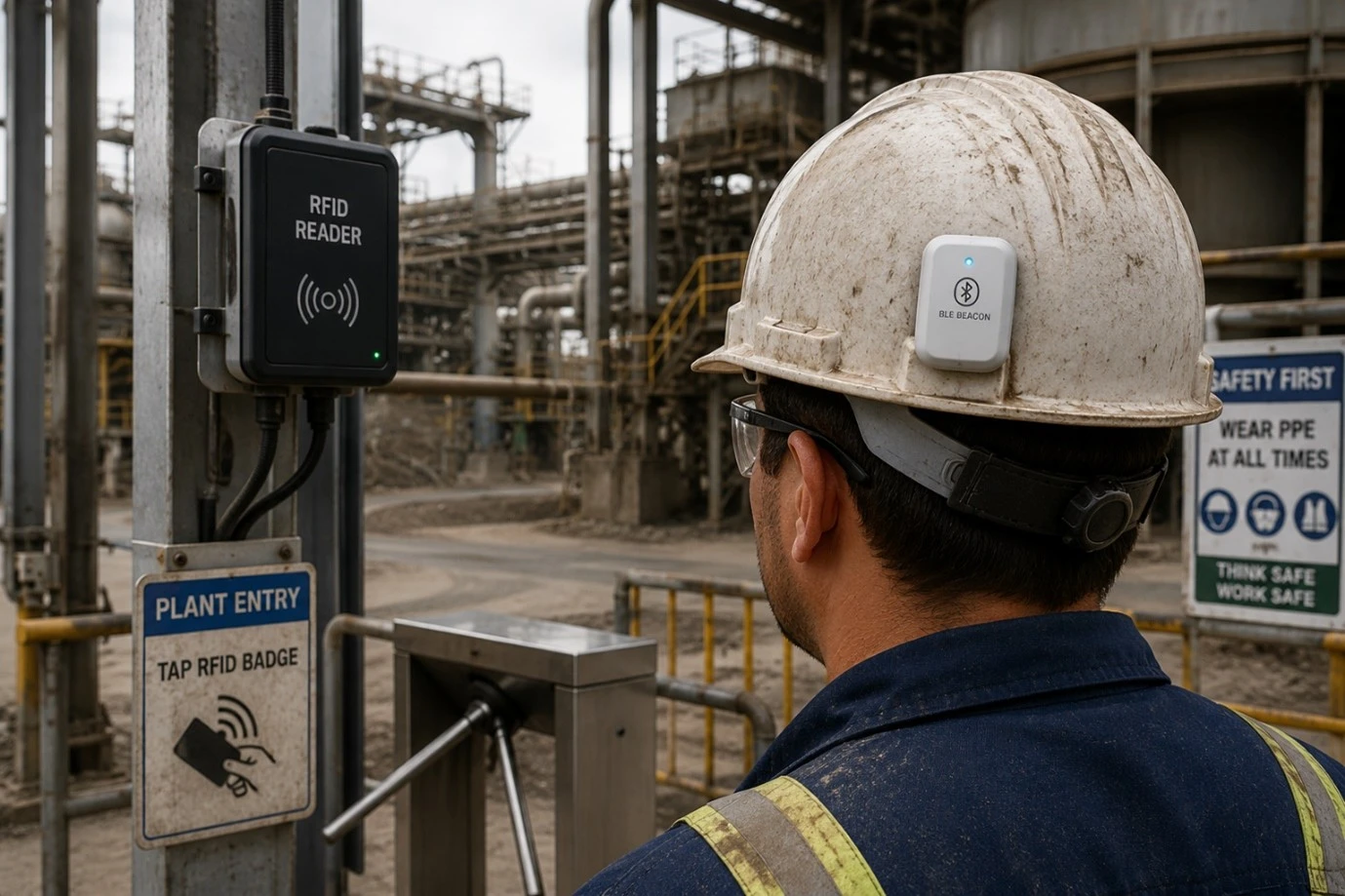
This image depicts two common identification technologies deployed in an industrial mineral processing facility: an RFID reader installed at a controlled plant entry point and a BLE beacon attached to a worker’s hard hat for real-time location awareness. Set within a rugged plant environment featuring piping, equipment, and dust exposure, the image highlights how identification hardware supports access control, workforce safety, and operational visibility. The key takeaway is that reliable field-level data begins with properly deployed identification hardware that connects personnel and assets to broader AIoT intelligence systems.
Identification Devices
Identification devices form the physical layer that RFID, BLE, and GPS-based AI functions depend on for accurate access control, personnel tracking, asset tracking, and traceability data.
RFID Tags and Readers
RFID tags and readers are typically installed at fixed access points including leaching bay entrances, smelter floor doorways, autoclave room entries, and refining line access gates. Passive and active RFID tags are used depending on required read range, with active tags generally preferred for larger zones such as concentrate handling areas where longer detection distances are needed.
BLE Beacons and Tags
BLE beacons and tags support personnel and asset tracking within open plant areas such as flotation banks, thickener zones, and concentrate stockyards, where fixed RFID checkpoints alone would not provide continuous positioning coverage. Beacons are commonly integrated into hard hats, wearable badges, or attached directly to mobile equipment and sample containers.
GPS Tracking Devices
GPS tracking devices are installed on mobile equipment and vehicles operating across stockyards, load-out areas, and roadways connecting processing and refining sections of a site, providing positioning data where fixed RFID or BLE infrastructure does not extend.
AI and RFID Technologies
AI and RFID technologies combine RFID identification hardware with AI software that interprets tag reads for access control and asset tracking purposes across mineral processing and refining zones.
AI and RFID Access Control
AI and RFID access control applies AI software to RFID reads at plant entry points, evaluating each read against zone-specific access rules and detecting anomalies such as credential sharing near leaching bays or autoclave rooms. This combination allows access decisions to be made automatically rather than through manual guard checks.
AI and RFID Asset Tracking
AI and RFID asset tracking applies AI software to RFID tag reads associated with mobile equipment, sample containers, and portable instrumentation, generating location updates as tagged assets move between crushing, flotation, and leaching areas.
AI and BLE Technologies
AI and BLE technologies combine BLE beacon hardware with AI software for personnel tracking and zone monitoring across open plant areas.
AI and BLE Personnel Tracking
AI and BLE personnel tracking applies AI software to beacon positioning data, generating real-time visibility of operator and maintenance crew locations relative to hazardous process equipment such as leach tanks and converters.
AI and BLE Zone Monitoring
AI and BLE zone monitoring applies AI software to beacon data to flag when personnel enter or remain within reagent storage or high-temperature smelting areas beyond expected time thresholds, supporting both safety compliance and incident response.
AI-Enabled RFID and BLE Hardware Combinations for Plant Operations
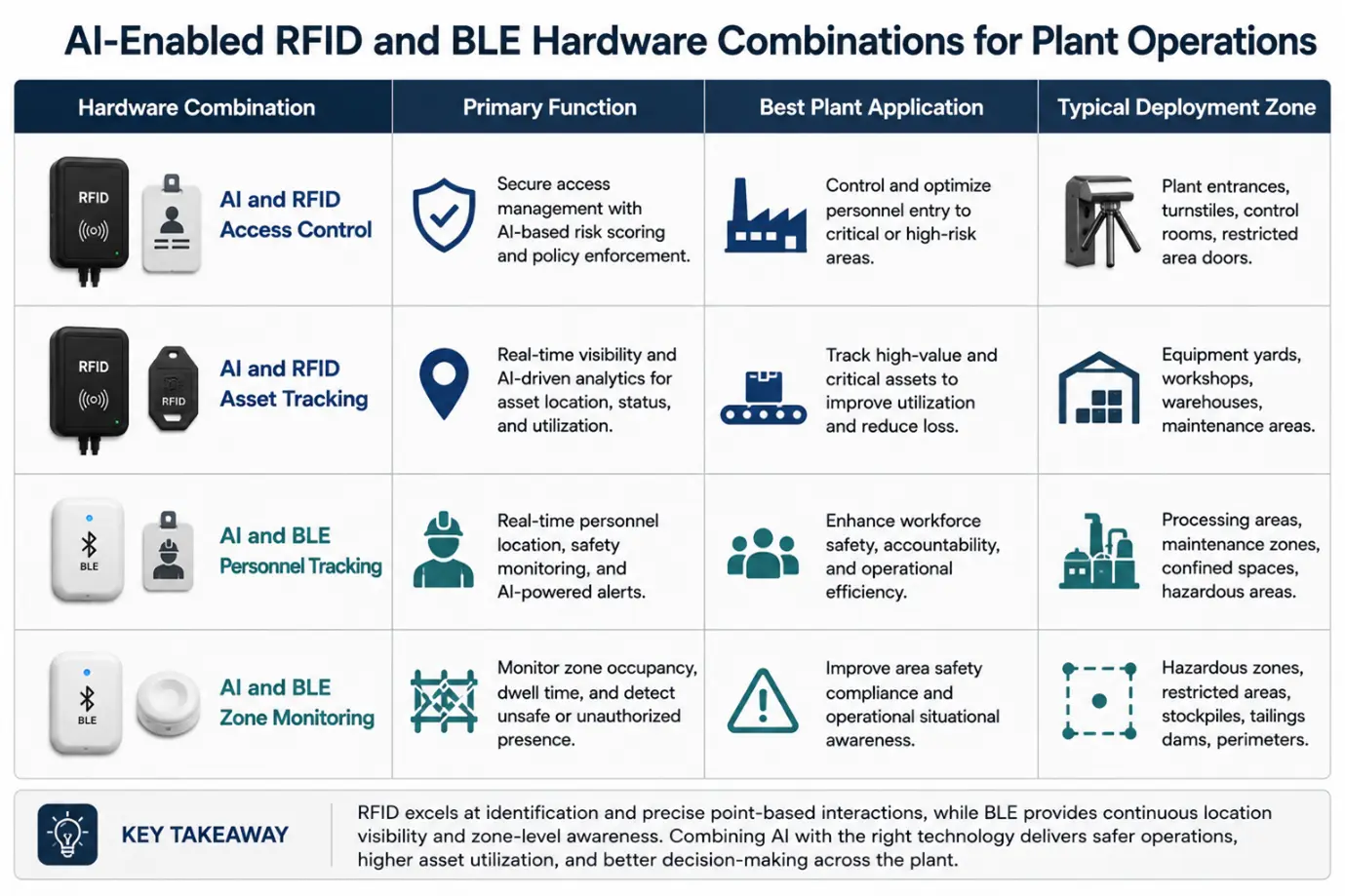
This comparison table evaluates four common AI-enabled identification technology deployments: AI and RFID Access Control, AI and RFID Asset Tracking, AI and BLE Personnel Tracking, and AI and BLE Zone Monitoring. For each solution, it outlines the primary operational function, the most suitable plant application, and the typical deployment environment. The key takeaway is that RFID and BLE technologies serve different but complementary purposes—RFID excels at identification and controlled interactions, while BLE provides continuous location awareness—and AI enhances both by transforming raw operational data into actionable intelligence for safety, compliance, asset utilization, and operational efficiency.
AI and GPS and Cellular Technologies
AI and GPS and cellular technologies extend identification and tracking coverage to mobile equipment and vehicles operating across larger plant areas, including stockyards and roadways connecting processing and refining sections.
AI and GPS Fleet Tracking
AI and GPS fleet tracking applies AI software to GPS positioning data from front-end loaders, haul trucks, and other mobile equipment moving concentrate between stockpiles and rail or port load-out points, supporting scheduling and utilization analysis.
AI and Cellular Asset Visibility
AI and cellular asset visibility maintains tracking continuity for equipment and assets moving beyond the range of fixed RFID or BLE infrastructure, using cellular connectivity to relay positioning data back to AI software for continued location intelligence.
Hardware Durability Considerations for Corrosive and High-Temperature Zones
Identification hardware deployed near flotation reagents, leaching agents, and smelting operations must withstand corrosive chemical exposure, elevated temperatures, and dust accumulation without degrading read reliability. RFID readers and BLE beacons installed near autoclave rooms or converter systems typically require sealed enclosures rated for the ambient conditions of those zones, while devices in general plant areas can use standard industrial-grade housings.
RFID readers near reagent storage and leaching areas require chemical-resistant enclosures
Chemical ExposureBLE beacons near smelting and converting operations require heat-tolerant housings
High TemperatureDevices across crushing and grinding areas require dust ingress protection
Dust ProtectionGPS units on mobile equipment require vibration-resistant mounting
Vibration ResistanceBrief Description of Applications
Identification hardware across mineral processing and refining plants supports access control at leaching bay and refining line entrances, personnel tracking across flotation banks, asset tracking for mobile equipment and sample containers, and fleet tracking for concentrate movement between stockyards and load-out points. Hardware selection depends on the specific environmental conditions of each plant zone.
Access Control at Leaching Bay and Refining Line Entrances
Personnel Tracking Across Flotation Banks
Asset Tracking for Mobile Equipment and Sample Containers
Fleet Tracking for Concentrate Movement Between Stockyards and Load-Out Points
U.S. and Canadian Standards and Regulations
ANSI/RIA R15.06
ANSI/ISA-95
ANSI/ISA-99 / IEC 62443
ANSI/ISA-18.2
ANSI/ISA-84 / IEC 61511
IEC 61508
IEC 62443 Series
IEC 61131 Series
IEC 61784 Series
IEC 62541 (OPC UA)
IEC 60204-1
IEC 60529
IEC 60079 Series
IEC 62264
ISO 9001
ISO 14001
ISO 14224
ISO 17363
ISO 17364
ISO 17365
ISO 17366
ISO 17367
ISO 17712
ISO 18185
ISO/IEC 18000 Series
ISO/IEC 14443 Series
ISO/IEC 15693
ISO/IEC 24730
ISO/IEC 29167 Series
ISO/IEC 27001
ISO/IEC 27002
ISO/IEC 27017
ISO/IEC 27018
ISO/IEC 30141
ISO 31000
ISO 55000
ISO 55001
ISO 55002
ISO 22301
IEEE 802.11
IEEE 802.15.1 (Bluetooth)
IEEE 802.15.4
Bluetooth Core Specification
EPCglobal Gen2 (GS1 EPC Class 1 Gen 2)
GS1 EPCIS
GS1 Core Business Vocabulary (CBV)
NIST Cybersecurity Framework (CSF) 2.0
NIST SP 800-53
NIST SP 800-82
NIST AI Risk Management Framework (AI RMF 1.0)
NIST Privacy Framework
OSHA 29 CFR 1910
OSHA 29 CFR 1926
MSHA 30 CFR Parts 1-199
Mine Safety and Health Act of 1977
Canadian Centre for Occupational Health and Safety (CCOHS) Guidance
Canada Labour Code Part II
Provincial Occupational Health and Safety Regulations (Canada)
CSA C22.1 Canadian Electrical Code
CSA Z432
CSA Z434
CSA Z460
CSA Z1002
CSA Z1006
CSA Z246.1
CSA Z246.2
Mining Association of Canada Towards Sustainable Mining (TSM)
Global Industry Standard on Tailings Management (GISTM)
Top Players
AI and IoT Identification, Personnel Tracking and Access Control
Industrial RFID, BLE and Identification Hardware
Industrial RTLS and Location Systems
GPS, Fleet and Mobile Asset Tracking
Mining Automation and Digital Mining Solutions
MES, ERP and Industrial Software
Industrial Networking and Wireless Infrastructure
AI, Edge Computing and Industrial Analytics
Case Studies
Phoenix, Arizona, USA
AI and IoT for Workforce Visibility, Access Control, and Mobile Asset Tracking in a Mineral Processing Facility
Problem
A large mineral processing and refining operation in Phoenix experienced persistent operational challenges associated with workforce visibility, contractor access management, and movement of mobile processing equipment across crushing, grinding, flotation, thickening, and concentrate handling areas. Personnel entered multiple controlled processing zones throughout each shift, making manual attendance verification and restricted area enforcement increasingly difficult. Maintenance teams also spent significant time locating specialized tools, mobile pumps, portable analyzers, forklifts, and critical maintenance assets distributed throughout the processing plant.
The operation required stronger compliance with internal safety procedures while improving operational efficiency. Manual sign-in procedures and conventional badge management created delays during shift changes and maintenance shutdowns. Equipment searches increased maintenance response times, while limited visibility into personnel distribution complicated emergency accountability during plant evacuations.
The organization required an AI and IoT solution emphasizing identification and location technologies rather than process monitoring, while supporting existing operational workflows throughout the mineral processing facility.
Solution
MineralProcess AI, drawing upon extensive implementation experience gained through GAO, GAO Tek Inc., and GAO RFID Inc., designed and deployed an AI and IoT workforce identification and asset location solution specifically for mineral processing and refining operations.
The implementation combined several identification technologies into a unified operational software solution.
Personnel identification included:
- BLE employee credentials
- RFID-enabled worker identification
- AI-assisted occupancy analysis
- Restricted area authorization software
- Digital contractor management
- Shift accountability automation
Access management included:
- RFID access credential validation
- BLE-based workforce identification
- AI-assisted access authorization
- Entry and exit event logging
- Digital permit verification
- Automated audit trail generation
Asset visibility incorporated:
- BLE Beacons attached to mobile maintenance equipment
- BLE Gateways positioned throughout processing buildings
- UHF RFID Readers covering maintenance storage areas
- UHF RFID Tags installed on portable processing equipment
- RFID Antennas supporting equipment identification
- RFID Reader Modules integrated into existing maintenance workflows
Our engineering teams selected BLE technologies for continuous indoor location awareness of frequently relocated assets, while RFID technologies supported rapid identification of maintenance inventory, spare components, and calibrated equipment.
Processing areas containing crushers, conveyors, flotation cells, mills, filter presses, reagent preparation rooms, concentrate storage, laboratories, maintenance workshops, and warehouse facilities were mapped into digital operational zones. AI software continuously evaluated movement patterns while supporting authorized workforce mobility between operational areas.
The deployment also incorporated Device Edge computing hardware from GAO Tek Inc. to process identification events locally before securely synchronizing operational records with enterprise software. This reduced communication delays while supporting continuous operation during temporary network interruptions.
Maintenance personnel received software dashboards displaying current equipment locations, historical movement records, workforce allocation, and authorized access events. Inventory personnel also utilized handheld UHF RFID Readers for accelerated verification of maintenance inventory before scheduled plant shutdowns.
Result
The AI and IoT deployment produced measurable operational improvements across workforce accountability and equipment utilization.
- Maintenance personnel significantly reduced time spent locating portable processing equipment.
- Worker accountability during emergency drills improved through automated personnel location records.
- Unauthorized entry attempts into controlled processing areas decreased following AI-assisted access validation.
- Shift change processing became more efficient through automated workforce identification.
- Inventory verification for maintenance shutdowns required substantially less manual effort using RFID identification.
- Equipment utilization increased because maintenance teams could rapidly locate available assets.
- Digital audit records simplified operational compliance reviews.
- Processing downtime associated with misplaced maintenance equipment was reduced.
The most significant operational improvement was a measurable reduction in equipment search time, allowing maintenance crews to return critical mineral processing equipment to production more quickly.
Lesson Learned
Combining BLE location technologies with RFID identification provided greater operational value than deploying either technology independently. BLE supported continuous workforce and asset visibility, while RFID accelerated inventory verification and maintenance logistics without introducing unnecessary operational complexity.
Salt Lake City, Utah, USA
AI and IoT for Inventory Traceability, Contractor Identification, and Processing Equipment Accountability
Problem
A mineral concentrator and refining operation supporting multiple ore processing circuits encountered increasing operational complexity as production expanded. Large quantities of replacement components, consumables, wear parts, flotation assemblies, grinding media, valves, electrical equipment, laboratory instruments, and maintenance tools moved frequently between central warehouses, maintenance facilities, processing areas, and temporary shutdown staging locations.
Manual inventory records often became outdated before maintenance activities concluded. Contractors working simultaneously with permanent employees required rapid authorization while maintaining strict access controls around reagent storage, electrical substations, concentrate storage facilities, and hazardous operational zones.
The organization also sought stronger traceability of work-in-progress equipment transfers between maintenance workshops and production departments while improving workforce accountability during scheduled shutdowns.
A solution emphasizing AI-enabled identification, access management, asset tracking, inventory management, and operational traceability was required for the mineral processing and refining environment.
Solution
MineralProcess AI implemented an AI and IoT software solution supported by practical deployment experience from GAO, GAO Tek Inc., and GAO RFID Inc., integrating RFID, BLE, and edge computing technologies throughout the processing facility.
Workforce identification component included:
- RFID employee identification
- BLE workforce credentials
- AI-assisted personnel movement analysis
- Contractor authorization management
- Restricted work area validation
- Automated attendance recording
Inventory management incorporated:
- UHF RFID Tags attached to maintenance inventory
- UHF RFID Readers installed at warehouse exits
- RFID Antennas covering inventory movement corridors
- RFID Accessories supporting high-read-rate inventory validation
Asset accountability included:
- BLE Beacons attached to portable process equipment
- BLE Gateways positioned throughout production buildings
- BLE Accessories supporting equipment identification
- AI software evaluating equipment movement history
Work-in-progress tracking supported:
- Maintenance equipment transfers
- Repair workflow visibility
- Component movement history
- Digital custody records
- Processing equipment staging management
Where outdoor movement occurred between warehouses, maintenance facilities, and concentrate storage locations, selected GPS IoT Trackers were deployed on high-value mobile equipment requiring extended operational visibility.
Device Edge computing hardware processed local identification events, reducing latency for operational decision support while maintaining continuous processing during temporary communication interruptions.
Our engineering teams configured AI software to correlate personnel identification records, authorized access events, inventory movements, maintenance workflows, and equipment transfers into unified operational reporting without exposing confidential production information.
Warehouse operators used RFID handheld readers to verify outbound maintenance kits before scheduled shutdown activities. Maintenance supervisors monitored equipment movement through software dashboards showing current locations, custody status, inventory availability, and authorized workforce assignments.
Result
The implementation improved operational control across inventory management and workforce accountability.
- Inventory reconciliation cycles became significantly faster through RFID-based identification.
- Maintenance teams reduced delays associated with locating specialized equipment.
- Contractor access management became more consistent through automated authorization workflows.
- Work-in-progress visibility improved throughout maintenance operations.
- Digital traceability supported improved documentation of equipment transfers.
- Warehouse inventory accuracy increased following automated identification.
- Maintenance shutdown preparation required less manual verification effort.
- Equipment accountability improved across multiple processing departments.
- Operational records became easier to review during internal compliance assessments.
The most significant measurable improvement was a substantial reduction in inventory verification time, enabling maintenance planning teams to prepare shutdown activities with greater operational efficiency.
Lesson Learned
Mineral processing and refining operations benefit most when inventory management, workforce identification, asset tracking, and work-in-progress traceability are implemented as complementary AI and IoT capabilities rather than isolated projects. Using BLE for continuous location awareness together with RFID for rapid identification created a practical operational solution that improved accountability without disrupting established maintenance procedures.
Duluth, Minnesota, USA
AI and IoT for Personnel Accountability, Traceability, and Processing Asset Management Across a Mineral Refining Operation
Problem
A mineral processing and refining operation in Duluth required improved accountability for employees, contractors, and maintenance personnel working across crushing circuits, grinding mills, flotation areas, concentrate filtration, material storage facilities, laboratories, and maintenance workshops. During routine operations and scheduled maintenance shutdowns, hundreds of personnel moved between controlled work areas, making manual verification increasingly inefficient.
The organization also experienced operational delays locating specialized maintenance equipment, portable inspection instruments, lifting devices, replacement assemblies, and mobile service carts. Equipment frequently changed locations during shutdown activities, reducing maintenance productivity and extending equipment turnaround times. Manual inventory reconciliation also made it difficult to verify maintenance materials before critical production outages.
Management required an AI and IoT solution centered on identification and location technologies capable of strengthening personnel accountability, access control, asset tracking, inventory management, and traceability throughout the mineral processing and refining operation.
Solution
MineralProcess AI implemented an AI and IoT solution based on deployment knowledge developed through GAO, GAO Tek Inc., and GAO RFID Inc., integrating RFID, BLE, and edge computing technologies across production and maintenance operations.
Personnel accountability included:
- BLE employee identification credentials
- RFID workforce badges
- AI-assisted workforce location analysis
- Digital contractor authorization
- Automated attendance verification
- Emergency accountability reporting
Access control capabilities included:
- RFID credential authentication
- BLE identity verification
- AI-supported access validation
- Restricted processing area authorization
- Digital access logging
- Compliance reporting
Asset tracking included deployment of:
- BLE Beacons attached to mobile maintenance assets
- BLE Gateways installed throughout processing buildings
- BLE Accessories supporting equipment identification
- GPS IoT Trackers for selected outdoor mobile equipment
Inventory operations incorporated:
- UHF RFID Readers
- UHF RFID Tags
- RFID Antennas
- RFID Reader Modules
- RFID Accessories supporting warehouse operations
Maintenance supervisors used AI software to review equipment movement histories, workforce allocation, inventory availability, and repair activities across multiple production departments.
During scheduled shutdowns, handheld UHF RFID Readers enabled rapid verification of replacement components before work orders were released. Maintenance teams also tracked specialized tooling throughout concentrator facilities, reducing delays associated with locating shared equipment.
Device Edge computing hardware processed identification events locally before securely synchronizing operational records with enterprise software. This approach minimized communication delays while maintaining continuous operational visibility.
Result
The deployment produced measurable operational improvements across maintenance, workforce accountability, and inventory operations.
- Personnel accountability during emergency response exercises improved through automated identification records.
- Equipment search activities required substantially less manual effort.
- Maintenance planning became more efficient through improved inventory verification.
- Authorized access records became more accurate and easier to audit.
- Work-in-progress traceability improved throughout maintenance shutdown activities.
- Warehouse inventory reconciliation required less time.
- Portable maintenance assets remained available through improved location visibility.
- Equipment utilization increased because maintenance crews could identify available assets more quickly.
The most significant measurable outcome was a considerable reduction in maintenance delays associated with locating mobile equipment and replacement components, improving production readiness during planned shutdowns.
Lesson Learned
Reliable workforce identification and equipment traceability become increasingly valuable during maintenance shutdowns where personnel movement and asset relocation occur simultaneously. Combining BLE location awareness with RFID identification supported operational efficiency without introducing unnecessary workflow changes.
Sudbury, Ontario, Canada
AI and IoT for Workforce Identification, Inventory Control, and Equipment Traceability in Mineral Processing and Refining
Problem
A mineral processing and refining facility supporting concentrator and refining operations sought improved visibility of personnel movement, contractor access, maintenance inventory, and mobile processing assets distributed across multiple production buildings. Existing manual procedures required extensive administrative effort to confirm worker locations, verify authorized access, reconcile maintenance inventory, and document equipment transfers between maintenance workshops and production departments.
Production planners also required better visibility into work-in-progress equipment repairs to improve shutdown scheduling and reduce unnecessary delays. Inventory personnel spent significant time confirming the availability of critical spare parts before maintenance activities could begin.
The organization required an AI and IoT solution emphasizing identification and location capabilities while supporting existing operational practices throughout mineral processing and refining operations.
Solution
MineralProcess AI designed and deployed an integrated AI and IoT solution leveraging practical implementation expertise developed through GAO, GAO Tek Inc., and GAO RFID Inc.
Personnel identification capabilities included:
- BLE workforce credentials
- RFID employee identification
- AI-assisted workforce allocation
- Contractor management software
- Digital attendance recording
- Restricted area authorization
Inventory management incorporated:
- UHF RFID Tags applied to maintenance inventory
- Fixed UHF RFID Readers at warehouse checkpoints
- RFID Antennas supporting inventory verification
- RFID Peripherals improving operational efficiency
Asset tracking capabilities included:
- BLE Beacons installed on portable processing equipment
- BLE Gateways positioned throughout production buildings
- BLE Accessories supporting equipment identification
- AI software analyzing movement history and equipment utilization
Work-in-progress management supported:
- Equipment repair traceability
- Maintenance workflow documentation
- Component transfer records
- Digital custody management
- Operational audit reporting
Selected high-value outdoor mobile assets were equipped with GPS IoT Trackers to improve visibility during transport between storage yards and processing facilities.
Device Edge computing hardware supported local processing of identification events before securely transmitting operational records to enterprise software.
Our engineering teams configured AI software to correlate workforce identification, inventory movements, maintenance activities, equipment transfers, and access events into unified operational reports supporting production management and maintenance planning.
Result
The implementation strengthened operational accountability throughout the mineral processing and refining operation.
- Maintenance inventory verification became faster using RFID identification.
- Personnel accountability improved through automated workforce records.
- Contractor authorization became more consistent across controlled processing areas.
- Equipment transfers became easier to document through digital traceability.
- Mobile asset availability improved through continuous BLE location awareness.
- Maintenance planning benefited from improved visibility of work-in-progress activities.
- Inventory accuracy increased through automated identification workflows.
- Compliance documentation required less manual administration.
- Equipment utilization improved by reducing time spent locating shared maintenance assets.
The most significant measurable improvement was a substantial reduction in inventory verification and equipment retrieval time, allowing maintenance teams to complete scheduled work with fewer operational interruptions.
Lesson Learned
Mineral processing and refining facilities achieve stronger operational performance when personnel identification, access control, inventory management, asset tracking, and traceability are implemented as a coordinated AI and IoT solution. Practical integration of BLE and RFID technologies improves operational visibility while preserving established production and maintenance procedures.